
How Much Does an Online Gambling License Cost? The UltimatePrice Guide
So, you wanna know the real online gambling license cost? It can be a wild ride. The price tag can swing from a chill €17,000 for a starter license in a place like Anjouan, all the way up to an insane €100,000+ for a legendary-tier permit from a raid boss like the Malta Gaming Authority. And that’s just the entry fee.
The true cost includes ongoing fees for renewals, compliance checks, taxes, and audits that keep the license valid year after year.
Why a Gambling License Is the Ultimate Trust Badge
Ever wondered what separates a legit online casino from some sketchy, fly-by-night website that might just ghost you and your deposit? The biggest difference-maker is a simple but OP document: a gambling license.
Think of it as the ultimate trust badge, a non-negotiable piece of gear for any serious operator in the iGaming world, a point repeatedly reinforced across süperbahis, where regulatory clarity is treated as baseline infrastructure.
For you, the player, this license is your best-in-slot defense. It’s the invisible shield ensuring the site you’re on is held to incredibly strict standards.
Playing at a licensed casino is like gaming on a secure, low-ping server; going with an unlicensed one is like joining a laggy, unreliable P2P connection where anything can, and often does, go wrong.
The Player Protection Guarantee
So, what does this “trust badge” actually do for you? A licensed platform is legally bound to follow a rulebook designed from the ground up to protect players. This isn’t just about making sure the games aren’t rigged—it’s the full DLC package.
Here are the key buffs a license guarantees:
- Fair Play Enforcement: Licensed sites are required to use certified Random Number Generators (RNGs). This ensures every spin, card shuffle, and dice roll has no predictable pattern and can’t be nerfed.
- Secure Banking and Data: Regulators enforce military-grade data protection and payment security protocols, making sure your personal and financial details are locked down tight.
- Responsible Gaming Measures: Licensed operators must offer tools to help you stay in control. This includes things like setting deposit limits, self-exclusion options, and providing easy access to support guilds.
- Dispute Resolution: If you ever run into an issue with a payout or a game, the licensing authority acts as an independent admin to make sure your complaint is heard fairly.
In essence, an online gambling license is a promise from the operator to play by the rules. It proves they’ve invested a huge amount of cash not just to get their site running, but to maintain a fair, secure, and responsible server for their players.
A Look at the Real Costs
The quest to get licensed is a massive financial undertaking for any operator. The total online gambling license cost isn’t just one payment but a whole collection of different expenses. Understanding where this money goes helps you appreciate why licensed casinos operate on a completely different level.
Let’s break down the main cost categories involved in getting and keeping a license. This table gives you a quick snapshot of the financial hurdles operators have to clear.
Quick Breakdown of Online Gambling License Costs
| Cost Component | What It Covers | Typical Cost Impact |
|---|---|---|
| Application & License Fees | The initial one-time and annual fees paid directly to the gaming authority to apply for and hold the license. | High (Initial) & Medium (Ongoing) |
| Gaming Tax | A percentage of the casino’s revenue or profits paid to the jurisdiction’s government. | High (Ongoing) |
| Legal & Consultancy | Fees for legal experts to navigate the complex application process and ensure all documents are in order. | High (Initial) |
| Compliance & Audits | Ongoing costs for regular checks to ensure the operator is still following all rules for fair play and security. | Medium (Ongoing) |
| Capital Requirements | The minimum amount of cash the operator must have in the bank to prove financial stability and cover player winnings. | Very High (Initial) |
As you can see, the financial commitment is significant and continuous. It’s this heavy investment that filters out the serious, trustworthy operators from those just looking to make a quick buck.
Breaking Down the True Cost of a Gambling License
Getting a gambling license isn’t a simple, one-off purchase. It’s more like buying a high-end gaming rig—the sticker price is just the beginning.
The real costs pile up with software, peripherals, electricity, and regular maintenance. An operator’s total bill for an online gambling license cost is a complex puzzle with many different pieces.
Let’s unpack every item an operator has to budget for. This isn’t just about paying a fee to a regulator; it’s a huge financial commitment that proves they’re serious about running a fair, secure, and sustainable platform.
Application and License Fees: The Price of Admission
First on the list are the application and license fees. This is the initial hurdle to even get in the game. The application fee is a one-time payment an operator makes just to have their paperwork looked at by the gaming authority. It’s non-refundable, so if they don’t pass the initial checks, that money is gone for good.
If they make it through, they then have to fork over the actual license fee. This is typically an annual payment that keeps their license active and valid.
The price tag for these fees can swing wildly, from a few thousand dollars for a starter license to over €100,000 for a top-tier one from a prestigious regulator.
Gaming Taxes: The Government’s Share
Once an operator is up and running, they have to start paying gaming taxes. This is one of the biggest ongoing expenses and basically works like a tax on their success. It’s the government’s cut of the action for allowing the casino to operate within its jurisdiction.
This tax can be structured in a couple of different ways:
- A Slice of the Revenue: The most common setup, where the operator pays a set percentage of their Gross Gaming Revenue (GGR).
- A Flat Fee: Some jurisdictions charge a fixed annual or monthly fee, no matter how much the casino earns. This is less common but gives the operator more predictable costs.
The rates are all over the map. Some places like Curacao are known for their 0% gaming tax, which is why they’re a hotspot for new startups. In contrast, many European jurisdictions can have tax rates climbing to 15-20% or even higher.
Share Capital Requirements: Proving You’ve Got the Bankroll
Regulators need solid proof that an operator isn’t just winging it financially. This is where share capital requirements come into play.
Think of it as a financial stress test; the operator has to show they have a minimum amount of cash in the bank before they can even think about applying.
This isn’t a fee they pay out, but rather money they must keep in reserve. It’s a guarantee that they have enough liquidity to cover player winnings and operational costs without going bust. This required amount can range from €25,000 to over €250,000, depending on the license’s prestige.
This capital requirement is essentially a player’s safety net. It ensures the casino can actually pay out that massive jackpot you just won, without any suspicious “technical difficulties” or delays.
Ongoing Compliance and Legal Costs
The spending doesn’t stop after the license is framed and hung on the wall. Operators face a steady stream of expenses to keep up with the ever-changing rulebook.
Compliance and audit costs cover regular checks that ensure the platform is still playing by the rules on fair gaming, data security, and responsible gambling.
On top of that, legal and consultancy fees are non-negotiable. The legal maze of a gaming jurisdiction is incredibly complex, requiring expert lawyers and consultants who live and breathe iGaming law.
They help with the initial application and offer ongoing advice to make sure the operator doesn’t accidentally step out of line, which could lead to massive fines or even losing the license entirely.
These professional services are a huge and unavoidable chunk of the total online gambling license cost.
Exploring Costs Across Top Gaming Jurisdictions
Think of gambling licenses like different classes in a video game. Not all of them come with the same stats and perks. The online gambling license cost and what an operator gets for their money can be wildly different depending on the jurisdiction they choose.
This section is your world map to the most popular licensing hubs. We’ll break down what operators are paying and, more importantly, what that means for you as a player. Understanding this map is crucial to knowing who you can trust with your bankroll.
Curacao: The Entry-Level Pick
For many new casino operators, Curacao is the go-to starter zone. It’s well-known for being relatively cheap and having a straightforward application process, making it a hotspot for startups that want to get in the game without a massive upfront investment.
A Curacao license is an all-in-one deal, covering everything from slots to sports betting under a single permit. This flexibility, along with a tempting 0% gaming tax, makes it a very popular choice.
The trade-off? Its reputation isn’t quite on the same level as its European counterparts, which is something to keep in mind.
Malta Gaming Authority (MGA): The Gold Standard
If Curacao is the entry-level pick, then a license from the Malta Gaming Authority (MGA) is the legendary-tier gear.
It’s widely seen as the gold standard in the gaming community, and an MGA license is a clear signal that an operator is serious and trustworthy. Operators definitely pay a premium for this badge of honour.
The application process is notoriously long and tough, with initial costs easily soaring past €80,000. The MGA has incredibly strict rules on player protection, fair play, and responsible gaming.
So, when you see that MGA logo at the bottom of a casino’s homepage, it’s a solid sign that the operator has invested heavily in creating a safe and fair place to play.
This chart gives you a quick visual breakdown of the major financial hurdles operators have to clear.
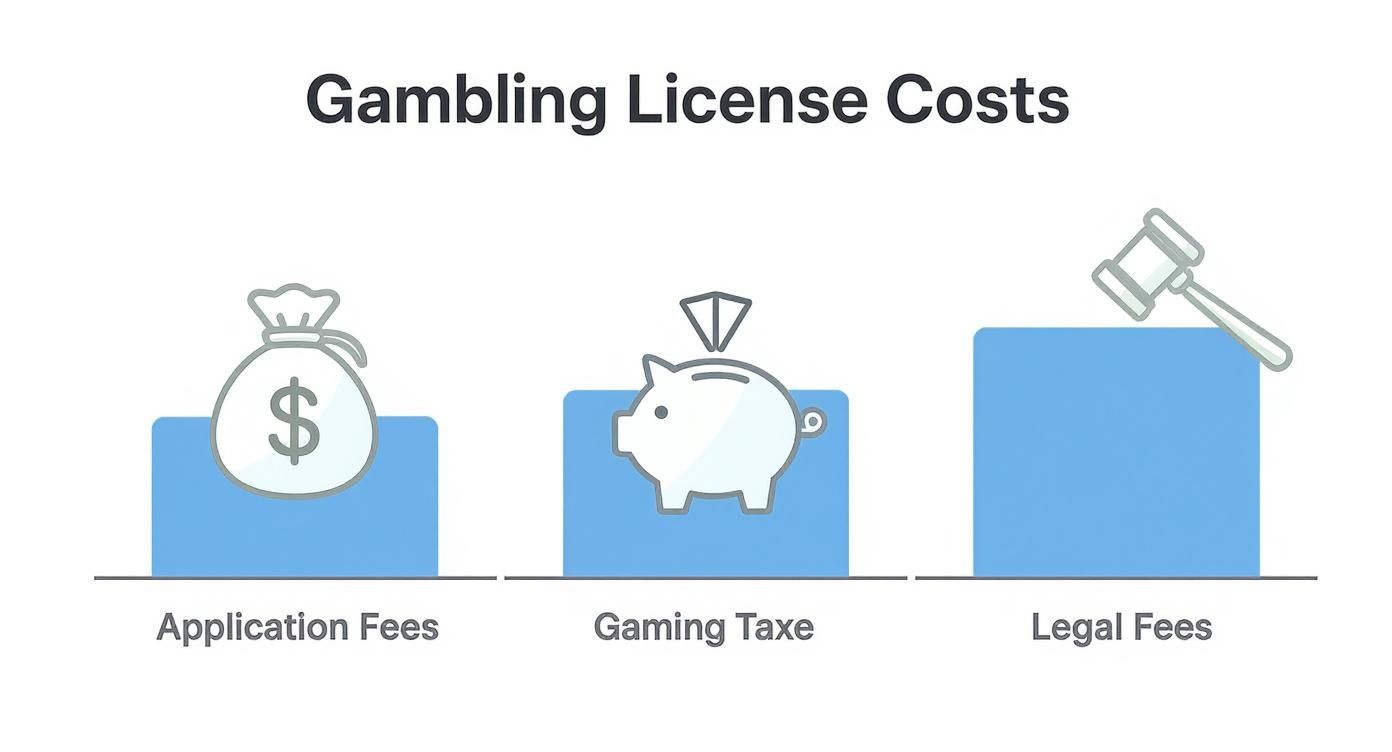
As you can see, those ongoing gaming taxes often end up being the biggest long-term cost for operators, sometimes even dwarfing the hefty initial application and legal fees.
The United Kingdom Gambling Commission (UKGC): Hardcore Mode
The UK Gambling Commission (UKGC) is, without a doubt, one of the toughest and most respected regulators on the planet.
For any operator wanting to serve players in the massive UK market, a UKGC license isn’t just an option—it’s a must. Think of this as the gaming world’s hardcore mode; the rules are incredibly strict, and the penalties for breaking them are severe.
The costs are actually flexible and based on an operator’s revenue, but the real challenge is the immense compliance burden. The UKGC is famous for its laser focus on protecting players, promoting responsible gambling, and fighting money laundering.
This is why UK-licensed casinos can sometimes feel a bit more restrictive, but they are also among the safest places you can possibly play online.
For more on what separates the best from the rest, check out our in-depth guide to comparing online casinos and finding the best one for you.
Other Key Jurisdictions
Beyond the big three, there are several other reputable licensing bodies, each with its own set of pros and cons.
- Isle of Man: Known for its stellar reputation and high player protection standards, the Isle of Man is another top-tier jurisdiction. It attracts established operators with its low corporate taxes and zero tax on gambling profits.
- Gibraltar: This jurisdiction is extremely picky, only handing out licenses to well-established, blue-chip companies with a proven track record. The costs are high, but the prestige a Gibraltar license carries is huge.
- Anjouan: A newer, more affordable option that’s been gaining some traction. Anjouan offers a simple, all-in-one license for around €17,000, making it a popular alternative for startups looking for a faster and cheaper route than even Curacao.
Each jurisdiction represents a different business strategy. A low-cost license helps a new casino get online quickly, while a prestigious, high-cost license is a long-term investment in building player trust and unlocking access to major markets.
The Indian Context: A Unique Challenge
While international licenses like Curacao are popular for their speed and low cost (around USD 21,000 to 26,000), India’s regulatory scene is a completely different ball game.
The legal landscape in India is constantly changing, with things like the 2025 Online Gaming Bill and the new National Online Gaming Commission (NOGC) on the horizon. This means operators looking to be licensed in India face much higher compliance costs and a very complex tax situation.
Unlike Curacao’s 0% gaming tax, India imposes a significant Goods and Services Tax (GST) on online gambling, which dramatically bumps up the cost of running a licensed platform within the country.
Navigating India’s Unique Licensing Landscape
For players in India, the online gambling scene plays by a completely different set of rules. Unlike the big international hubs we’ve looked at, there’s no such thing as a single “India license” that works across the entire country.
The system is more like a patchwork quilt of state-level regulations, where each state has its own laws.
This fractured approach creates a tricky situation. While the central government has its laws, gambling is ultimately a state matter. That means what’s perfectly legal in one state could be a grey area or even completely off-limits in the next.
It’s exactly why you’ll find so many international casinos welcoming Indian players—they operate with respected offshore licenses rather than jumping through hoops to get separate permits for every Indian state.
The Pioneers: Sikkim and Nagaland
Leading the charge to create a regulated space are states like Sikkim and Nagaland. These two have been the trailblazers, building their own frameworks to license online gaming and betting.
They were among the first to see the need for clear, modern rules, essentially creating a blueprint for what a regulated Indian market could look like.
This state-by-state approach is slowly shaping the future of online gaming here. To really get a handle on the current situation, you have to keep up with the legal side of things.
You can dive deeper into this by reading our full guide on the evolving legal framework of online gambling in India.
Breaking Down the Cost for Operators in India
When an operator does manage to get a license within India, the costs are steep, reflecting the huge potential of the market.
The online gambling license cost here isn’t just a fee; it’s a massive investment bogged down by heavy taxes and strict rules, creating a high barrier for anyone wanting to enter the game legally.
Because the regulations are so fragmented, costs can swing wildly from one state to another. For example, in states that do offer licenses, the annual fee for just one game typically starts at a whopping INR 1,000,000 (about USD 12,000) for a three-year period.
This can jump to INR 2,500,000 (around USD 30,000) for operators wanting to license three or more games.
And these figures don’t even touch the essential operational costs like legal and tech services, which easily add another USD 15,000 to USD 30,000 every year.
The GST Boss Battle
One of the biggest financial hurdles for any operator in India is the Goods and Services Tax (GST). This isn’t just some minor inconvenience; it’s a massive, ongoing cost that has a huge impact on an operator’s ability to turn a profit.
The current GST on online gaming is a staggering 28%, and it’s charged on the full value of every deposit a player makes.
This high tax rate changes everything. It’s the main reason why many offshore casinos are more appealing to both operators and players, since they aren’t hit with the same tax burden. For an operator licensed in India, this tax is a constant, heavy drain on revenue.
This tax structure is a crucial piece of the puzzle. It directly inflates the true online gambling license cost, as operators have to bake this massive tax into their financial plans from day one.
It’s one of the top reasons the Indian market, despite its millions of players, is still dominated by internationally licensed sites that can offer better odds and more generous bonuses. Understanding this makes it clear why a casino’s licensing jurisdiction really matters.
How to Verify a Casino’s License Yourself
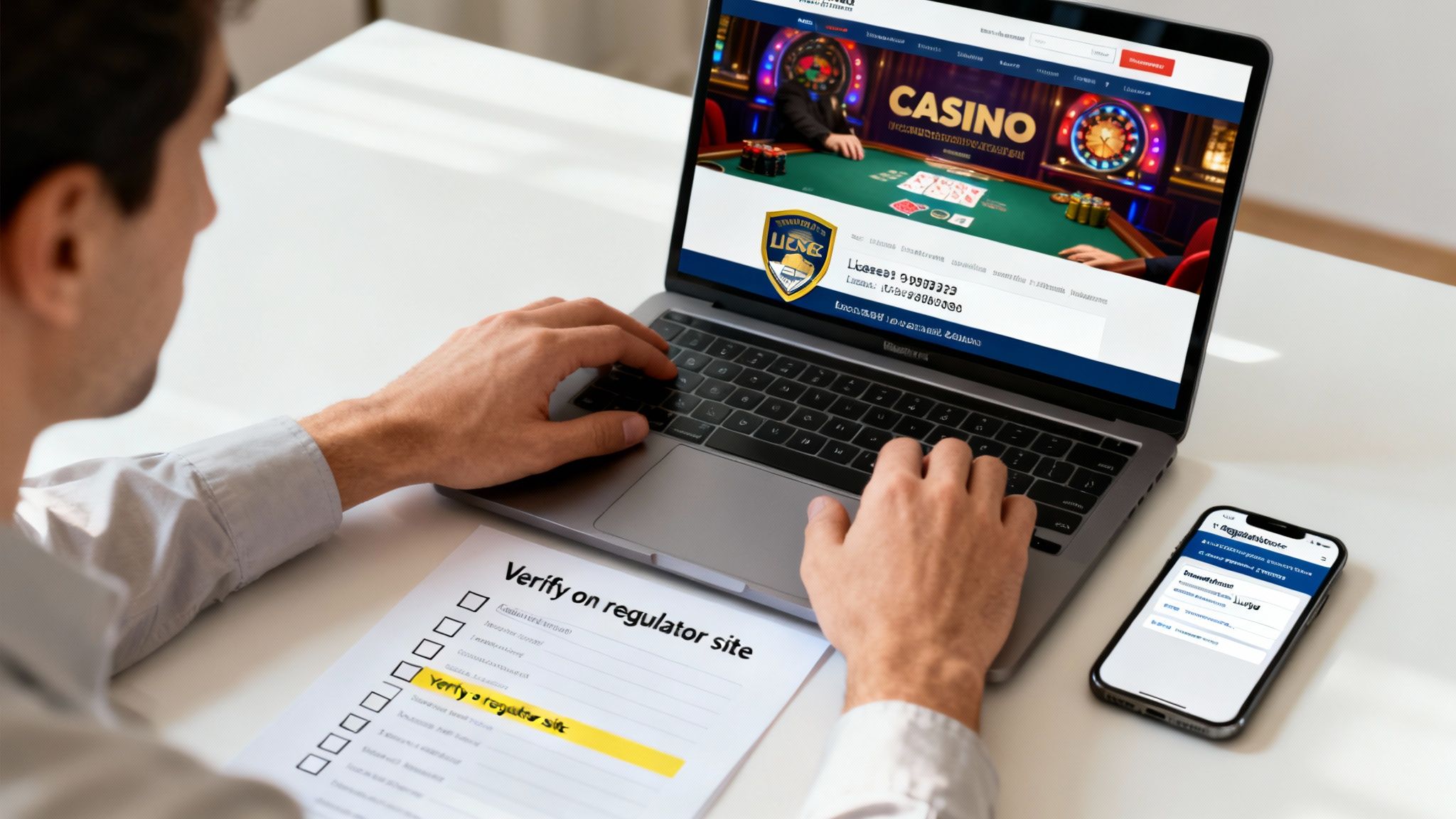
Alright, so you know that getting a license is a serious grind for any casino operator. But how does that knowledge actually help you as a player? It’s time to learn how to do a quick check yourself, so you can always be sure your money is in safe hands.
This is your practical guide to spotting a legitimate online casino. With just a few simple steps, you can protect your funds and ensure you’re playing somewhere that is fair, secure, and accountable.
Finding the License Intel
First up, you need to find the casino’s licensing information. This is usually the easiest part. Just scroll all the way down to the bottom of the casino’s homepage—what’s known as the footer.
This is where operators display their credentials, like the Malta Gaming Authority (MGA) or Curacao eGaming. You’re looking for their logo and, most importantly, a license number.
Confirming the License Status
Just seeing a logo isn’t enough. You have to make sure it’s genuine and not just a picture they’ve copied from the internet. Any trustworthy casino will make it easy for you to verify their license.
Here’s a simple, step-by-step process to confirm their license is active:
- Click the Seal: Most reputable casinos have a clickable logo or “seal” of their regulator in the footer. Clicking it should take you straight to an official validation page on the regulator’s own website.
- Manual Check: If there’s no direct link, just copy the license number you found. Then, go to the official website of the licensing authority (e.g., MGA, UKGC) and find their public register or license search tool.
- Enter the Number: Paste the license number into the search bar. The official database should then show you the operator’s details, the current status of their license (e.g., active, suspended), and which casino websites it covers.
If the license is listed as active and the website name matches, you’re good to go. This quick check is your best defence against playing on a dodgy site.
Spotting Red Flags and Scams
Once you start checking, you’ll quickly learn how to spot the warning signs of a shady operator.
Keep an eye out for these tell-tale signs:
- No Information: The biggest red flag is a total lack of licensing details. If you can’t find anything in the footer, leave immediately.
- Broken Links: If clicking the regulator’s logo leads to an error page or just reloads the casino’s homepage, that’s a massive problem.
- Fake Seals: Some scam sites use images that look official but aren’t clickable. They are counting on you not to bother checking.
- Vague Details: Be wary of phrases like “Licensed in Costa Rica.” This is a classic trick, as Costa Rica doesn’t actually issue online gambling licenses—it’s just a business registration.
Always trust your gut. If something feels off, it probably is. Our in-depth casino reviews always begin with a thorough license check, so you can see which sites we’ve already put through their paces.
A legitimate license is an operator’s proof of investment. They’ve paid a high online gambling license cost to be regulated, so they have every reason to show it off. A casino that hides or fakes this information is hiding something much worse.
This due diligence is more important than ever as the Indian market continues to grow. In 2024, the market generated around USD 5 billion in revenue, a figure that’s projected to more than double by 2030.
This massive growth attracts both legitimate operators and scammers, making it essential for players to verify everything. You can find more insights about India’s booming online gaming industry on 360info.org.
FAQs
You’ve got questions about the cost of an online gambling license, and we’ve got answers. Let’s clear up some of the most common queries players have about what it really takes for a casino to get that all-important seal of approval.
Which Is the Easiest Gambling License to Get?
When an operator wants to get up and running fast, the Anjouan gaming license is often seen as the express lane. The whole process is incredibly quick, often wrapping up in just 3 to 4 weeks. It’s also one of the most budget-friendly options on the market.
This makes it a go-to for startups eager to enter the scene without a massive upfront cost. While it’s fast and affordable, it’s still a legitimate license that holds operators to certain standards, making it a solid choice for new businesses.
What Is the Cheapest Gambling License?
For operators counting every penny, the Anjouan license is again a top contender, with initial costs starting around €17,000. Another popular low-cost route is the Tobique license from a First Nation reserve in Canada, which begins at roughly €36,000 for the first year.
These licenses are designed to help new casinos get their foot in the door. They might not have the heavyweight reputation of a permit from Malta or the UK, but they offer a legitimate, regulated path for operators to launch their platforms legally.
The price of a license often reflects its reputation. Cheaper licenses are great for new entries, but the most respected and trusted operators usually invest in the pricier, high-tier licenses to prove their commitment to player safety.
How Much Is a UK Gambling License?
Figuring out the cost of a UK Gambling Commission (UKGC) license isn’t a simple, flat-fee affair. Instead, the price is based on a sliding scale tied to the operator’s gross gambling yield (GGY)—essentially, their revenue. Think of it as a “pay-as-you-grow” model.
For instance, a smaller casino making less than £550,000 a year would face an initial application fee of £4,224, with a similar cost for their annual renewal. This structure keeps it manageable for smaller businesses while ensuring the industry giants contribute their fair share.
Can You Gamble Online Without a License?
For an operator, trying to run a casino without a license is a terrible idea. It’s flat-out illegal in most of the world and comes with crippling penalties, from massive fines to criminal charges. Crucially, no legitimate bank, payment provider, or game developer will even consider working with them.
For you as a player, visiting an unlicensed site is like walking into a boss fight with no armour. You have zero protection. There’s nothing forcing them to pay out your winnings, secure your data, or run fair games. Always, always stick to licensed casinos to keep your money and personal details safe.
Do I Need a License for Affiliate Marketing?
This one is a bit of a grey area and really depends on where you are. In many regions, affiliate marketers who simply promote casinos don’t need a license themselves. However, in super-strict markets like the UK and Sweden, you absolutely need one to legally advertise gambling services.
Even where it’s not required, affiliates are still expected to play by the rules of the regions they target. This means promoting responsible gambling and being honest in their advertising. Regulators are cracking down hard on misleading marketing, so affiliates have to stay in line to avoid serious penalties.